
AREF Theory of Change
Developing Researchers. Strengthening Institutions. Enhancing Research Ecosystems.
Our Team
Get Involved
Partners and Supporters
Context
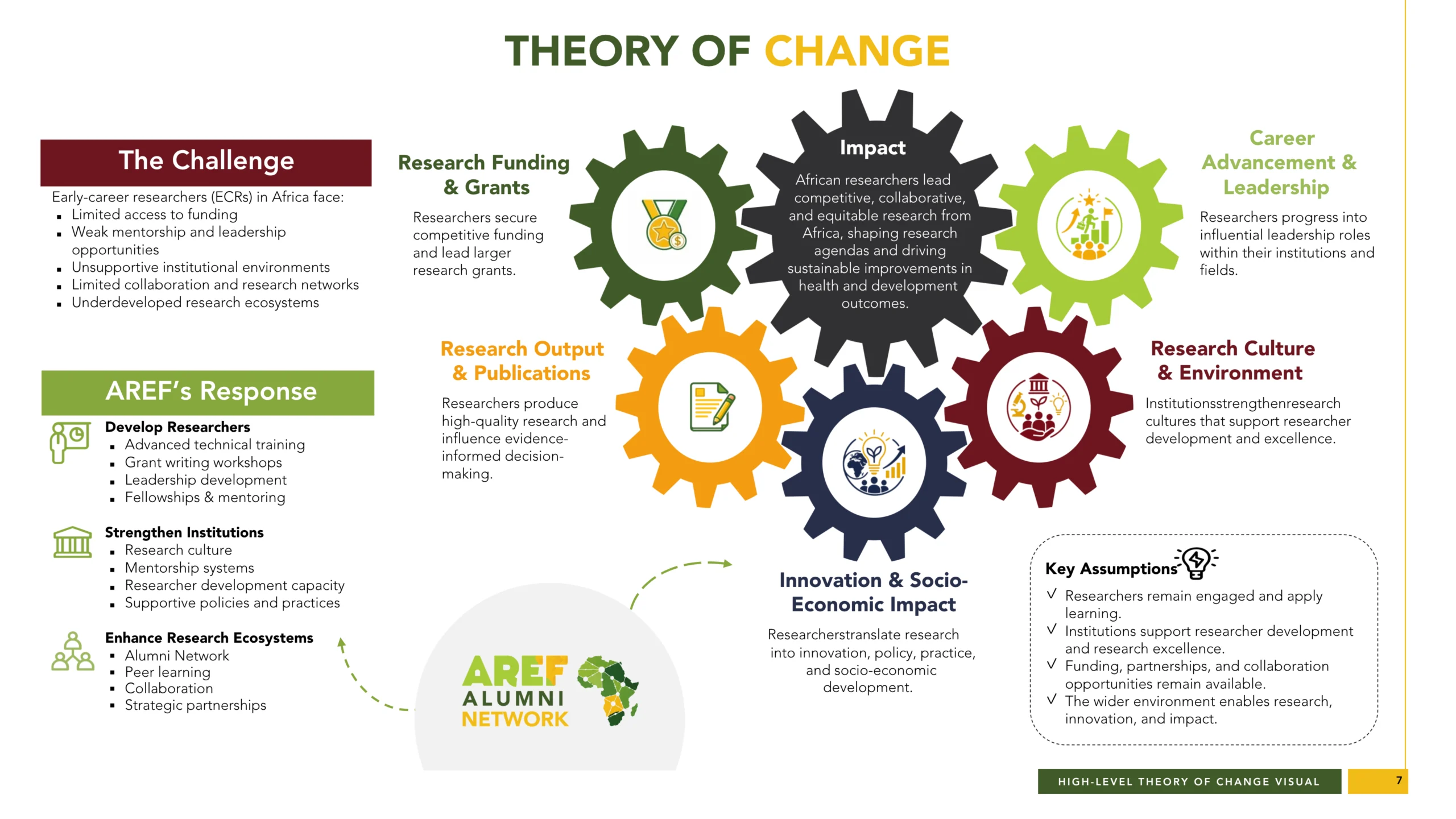
Across Africa, many early-career researchers face barriers to funding, mentorship, leadership opportunities, supportive institutional environments, research infrastructure and research networks. These challenges limit research independence, productivity, and impact, highlighting the need for coordinated action to strengthen researchers, institutions, and research ecosystems across the continent.
How Change Happens
At the heart of AREF's approach is a clear causal logic that links its interventions to long-term impact.
IF
Early-career researchers receive integrated support to develop technical and leadership skills, access mentorship, pursue funding opportunities and grow networks
AND IF
Research institutions are engaged to strengthen policies, systems, mentorship structures and incentives
THEN
Researchers develop the skills, confidence, and networks to apply their learning, while institutions become better equipped to support them.
OVER TIME
Researchers advance into leadership, institutions embed supportive research cultures, and research outputs increase in quality and impact.
ULTIMATELY
This results in stronger research systems, increased innovation, and greater influence of African researchers and institutions in shaping African and global health research priorities, policy and sustainable development solutions.
Pathways to impact
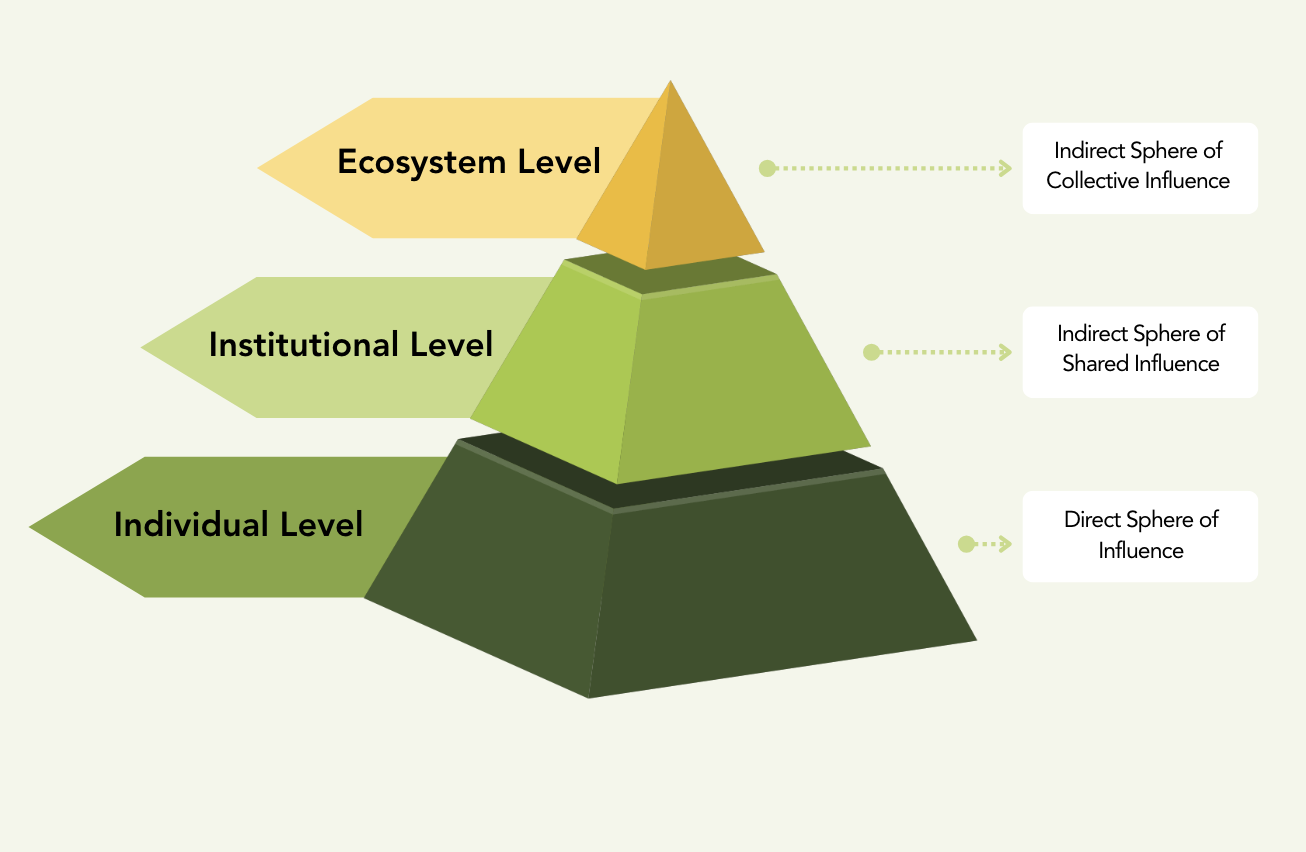
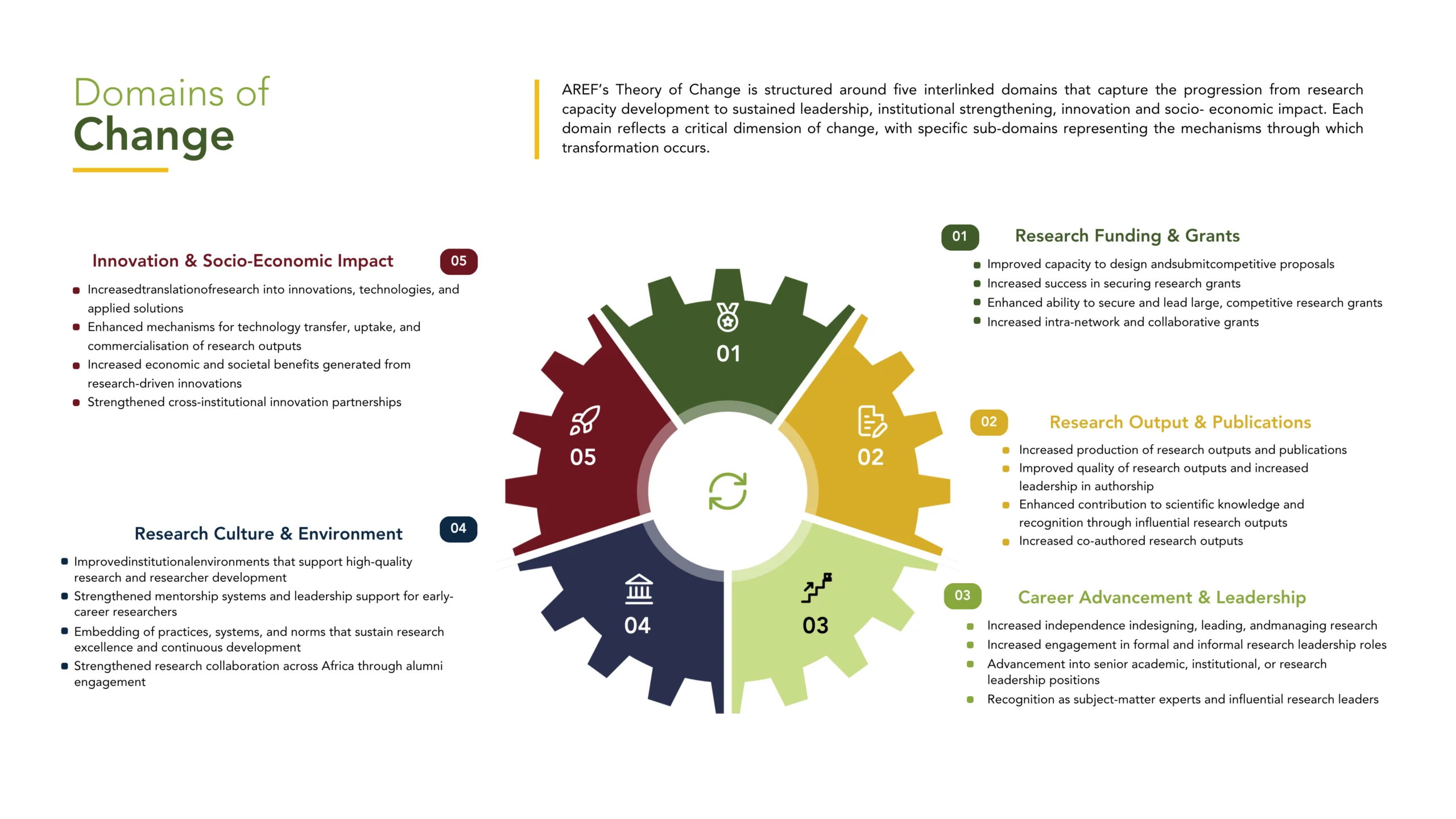
AREF’s programmes create a reinforcing pathway of change that extends beyond individual researchers:
At the individual level, participants build the skills, confidence, and networks required to succeed.
At the institutional level, these gains are translated into improved research culture, mentorship, and support systems.
At the ecosystem level, increased collaboration and leadership contribute to a more connected and influential African research community.
Through this process, AREF contributes to a gradual but meaningful shift, where African researchers are not only participating in global research, but increasingly leading it, shaping priorities, and ensuring that research is grounded in local realities and needs.
A learning Journey
AREF’s Theory of Change is dynamic and evolving. The organisation recognises that outcomes are shaped by context, readiness, and enabling conditions, and that change does not occur uniformly across settings. As such, it represents AREF's contribution to strengthening research leadership and research systems, rather than direct attribution of long-term impacts.
Through continuous reflection on experience and evidence, AREF refines its understanding of what works, for whom, and under what conditions, enabling it to maximise its contribution to research leadership and capacity strengthening across Africa. As a living framework, the Theory of Change is reviewed annually to ensure that its interventions remain relevant and that its underlying assumptions continue to reflect evolving contexts.
Evidence generated through AREF's monitoring, evaluation, and learning processes informs strategic decision-making, programme design, and continuous improvement, ensuring that the organisation's work remains evidence-informed, needs-driven, and impact-oriented.
Design treatment: This should be visually quieter than the preceding sections. It is the closing reflection rather than another infographic-heavy section.
Explore theFull AREF Theory of Change
Read the full Theory of Change to explore our pathways of change, Domains of Change, assumptions, risks and mitigation measures, and our approach to monitoring, evaluation and learning