
The Africa Research Excellence Fund (AREF) has launched an updated organisational Theory of Change, setting out a clearer and more ambitious framework to develop researchers, strengthen institutions, and drive sustainable growth across Africa’s research ecosystems. Approved by AREF’s Board of Trustees in September 2026, the new Theory of Change updates AREF’s original 2019 model to reflect over a decade of growth, institutional learning, and expanding programmatic ambition.
Over the past decade, AREF has grown significantly in its reach, programme portfolio and ambition. Since its establishment in 2015, AREF has supported more than 1,314 health researchers across 43 African countries, helping emerging research leaders develop the skills, experience, networks and opportunities they need to advance their careers and undertake research that responds to Africa’s health priorities.
As AREF has grown, its work has also increasingly demonstrated that developing excellent researchers cannot happen in isolation. Researchers need supportive institutions, equitable partnerships, strong professional networks and research environments that enable them to thrive.
The new Theory of Change captures this broader understanding of how sustainable change happens.
Developing excellent researchers cannot happen in isolation," noted Prof Akhere Omonkhua, AREF CEO. "Emerging leaders need supportive institutions, equitable partnerships, and robust environments to truly thrive. Our updated Theory of Change captures this broader, systemic understanding of how lasting impact is achieved."
From researchers to institutions and research ecosystems
At the heart of the new Theory of Change is a progression across three interconnected levels of change:
Develop Researchers → Strengthen Institutions → Enhance Research Ecosystems
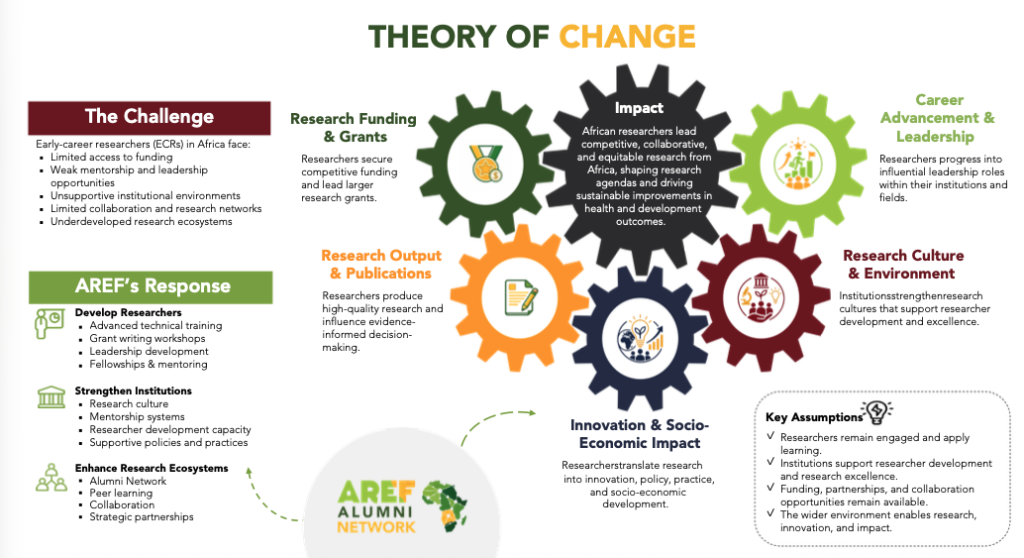
AREF continues to place individual researchers at the centre of its work, supporting them to build their research, leadership and professional capabilities and become increasingly competitive, independent and influential research leaders.
But the framework also recognises that individual excellence can have wider effects. As researchers progress, lead teams, mentor others, establish collaborations and influence their institutions, they can contribute to stronger research cultures and institutional capacity.
Over time, these changes can contribute to a broader African research ecosystem in which researchers and institutions are better connected, more competitive, more equitable and increasingly able to generate and translate high-quality research into improvements in health and development.
AREF recognises that these longer-term changes cannot be achieved by any single organisation. The new Theory of Change therefore makes an important distinction between the outcomes AREF can directly influence and the wider institutional and ecosystem changes to which AREF contributes alongside researchers, institutions, funders, governments and other partners.
Five interconnected domains of change
The new framework organises AREF’s contribution around five mutually reinforcing domains of change:
- Funding & Grants
- Research Outputs & Publications
- Career Advancement & Leadership
- Research Culture & Environment
- Innovation & Socio-Economic Impact
Rather than treating these areas as separate outcomes, the Theory of Change recognises the relationships between them. Increased research capability can improve researchers’ competitiveness for funding; funding can enable new research and collaborations; research can generate publications, innovation and policy or practice influence; and researchers who progress into leadership positions can create opportunities for others and help strengthen their institutions.
The framework also recognises important cross-cutting areas that support change across these domains, including equity and inclusion, AREF’s Alumni Network, and climate and environmental sustainability.
Developed through evidence, consultation and learning
The new Theory of Change is the result of an extensive review and consultation process.
AREF reviewed its existing Theory of Change alongside programme evidence and organisational learning accumulated through its work with researchers and institutions. The process included engagement with AREF staff and senior leadership, AREF Alumni, Trustees, funders, partners and external experts, followed by several rounds of review and refinement.
A final organisational validation process confirmed broad agreement that the revised framework provides a credible representation of AREF’s work, priorities and future direction.
Importantly, the process was not simply about creating a new diagram. It was about making the assumptions behind AREF’s work more explicit and developing a stronger framework for understanding, measuring and learning from change.
Turning Strategy into Measurable Evidence
The new Theory of Change will now provide a common strategic foundation for AREF’s programme design, monitoring, evaluation and learning, organisational planning and external communication.
It will be operationalised through AREF’s Results Framework and Monitoring, Evaluation and Learning system, supported by strengthened data systems and longitudinal tracking of researchers, alumni and institutions.
This will allow AREF not only to measure programme delivery, but increasingly to examine longer-term questions: How do researchers progress after participating in AREF programmes? How does researcher development contribute to institutional change? What enables or constrains those pathways? And where is AREF making its strongest contribution to Africa’s research ecosystem?
The Theory of Change will therefore remain a living framework. As AREF generates new evidence and learns more about how change happens, its assumptions and pathways will continue to be tested and refined.
Looking ahead
The launch of the new Theory of Change marks an important step in AREF’s development as it enters its second decade.
It provides a clearer articulation of an ambition that has been central to AREF since its creation: to enable talented African researchers to realise their potential and contribute to a stronger, more equitable and sustainable African research environment capable of addressing the continent’s health challenges.
Explore AREF’s new Theory of Change
The high-level framework above provides an overview of how AREF seeks to contribute to change. For a deeper exploration of the pathways, domains of change, assumptions and evidence underpinning the framework, read or download the full AREF Theory of Change Version 2.0 /Click to Download_Theory-of-Change
ENDS
Notes for Editors
For media inquiries, contact:
Communications Team, aref@aref-africa.org.uk
Africa Research Excellence Fund
The Africa Research Excellence Fund (AREF) was founded by Professor Sir Tumani Corrah KBE in 2015.
Professor Corrah founded AREF to support the careers of the new generation of African researchers, giving them the stepping stones needed to become outstanding research leaders in their respective fields, ensuring that talent is retained in Africa to address the continent’s unique health research needs.
AREF’s vision is of an inspired, committed, and talented community of researchers in Africa leading world-class research and participating equitably in international research endeavors for health and wellbeing.